How it works
Your first answer in about 10 minutes
Answer five real scenarios, then chat with your twin and see why it answered the way it did. A deeper interview of 30 to 40 minutes is there when you want it, and it is optional.
Four steps to a twin you can check
Answer five real scenarios
About 10 minutes. Say what you would do and why, in your own words. Each answer becomes evidence.
Chat with your twin
Ask it something new and see why it answered that way: the principles and evidence it used.
Correct anything it gets wrong
Your correction outranks everything else in your reasoning graph, and it sticks.
Share one link
Send it to your team or clients, or embed it on your site.
Optional: deepen your twin with the full interview (30 to 40 minutes) and your own documents.
Optional: the full interview
Six layers of context, when you want more depth
The full interview takes 30 to 40 minutes and covers your context, expertise and style. It sets the stage. Your reasoning graph, built from what you actually decide, is what your twin reasons from.
How You Decide
Your judgement
Your principles, priorities, and trade-offs. When someone asks your twin for a recommendation, this is what shapes the answer.
What You Know
Your expertise
Your documents, writing, and professional experience. Your twin draws exclusively from your material, not the open internet.
What You Do
Your real-world context
Your role, your audience, your domain. Your twin understands who it's talking to and adapts accordingly.
How You Think
Your reasoning
Your mental models, frameworks, and problem-solving approach. This is what separates your twin from a generic chatbot.
How You Communicate
Your voice
Your tone, vocabulary, humour, and conversational patterns. Your twin doesn't just know the right answer. It delivers it the way you would.
Experience Bank
Your real examples
Real stories, case studies, and examples from your career. Your twin backs up its reasoning with things that actually happened.
One model of you, several twins
An Imprint is the model of you; twins are versions of it for different audiences. A client-facing twin, a team twin, a mentoring twin. All reason from the same graph.
Choose a model strength for each twin: Swift for fast routine Q&A, Sharp as the everyday default, or Brilliant for the hardest questions. The models are Anthropic's Claude. What is Imora's own is your reasoning graph and how it retrieves your decisions.
Not just facts. A graph of how you decide.
Many AI twin tools store your knowledge as flat text: a bio, some documents, a list of preferences. Imora stores your decisions as evidence, distils them into principles with the conditions they apply under, and links them into a graph your twins reason from.
Evidence links to principles
Your twin doesn't just know you chose to ship early once. It holds the principle behind it, the condition it applied under, the exception, and the exact answer it came from. Every principle is traceable to your words.
Conditions, not averages
You move fast when a call is reversible and slow down when trust is at stake. Most tools would average that into one risk score. Imora keeps both, and your twin knows which applies.
One graph, many lenses
Your graph lives at the person level, not the twin level. Create a board twin, a mentor twin, a pricing twin. Each sets an audience, focus and tone. All of them reason from the same evidence, and every answer says whose judgement it is.
Shared Drives for live documents
Connect org-level document collections to specific twins. Upload strategy docs, policies, or technical specs to a Shared Drive and assign it to twins. They always have the latest information when answering questions.
Only your words make it grow
Calibration answers, corrections, what you tell your own twin and documents you wrote all become evidence. Only you teach your twin. Nothing a visitor says changes how it thinks.
This is how an Imora twin approaches a question it has not seen before: it reasons from your principles and evidence, and tells you how sure it can be.
Calibration
Keep your twin current
People change. Your thinking sharpens, your priorities shift, your experience deepens. Short calibration sessions keep your twin up to date.
Imora offers new scenarios
Imora surfaces a short set of scenarios tailored to your domain and expertise. No generic quizzes. Real situations relevant to what you do.
You respond naturally
Answer in your own words, the way you would in a real conversation. There are no right or wrong answers. Imora is mapping how you reason, not testing you.
Your graph grows
Your answers become evidence, principles are re-distilled, and new links and themes appear. Nothing is flattened; replaced ideas stay as history you can replay.
Every twin gets sharper
The updated graph flows into every twin you own immediately. The result: twins that reflect who you are now, not who you were six months ago.
Example calibration scenario
Imora
A client asks you to take on a project outside your core expertise, but the fee is significant and the timeline is tight. How do you approach this?You
I'd be honest about where my expertise ends. If I can add value on the strategic framing, I'd scope it to that and recommend a specialist for the rest. Taking the full fee for work I can't deliver well damages the relationship long term.Takes about 5 minutes. No scheduling required.
Mirror Score
Track how much of you your twin captures
Mirror Score is a completeness measure: it rises with depth and coverage. Accuracy is measured separately, on answers held back from your twin.
Basic mirror
Knows what you know. Gives accurate information but sounds generic.
Solid representation
Understands your context and applies your reasoning. Starting to sound like you.
Strong twin
Applies your reasoning and your tone across most of the questions it is asked.
High fidelity
Draws on real examples from your career and backs its reasoning with them.
The reasoning graph
How Imora learns the way you decide
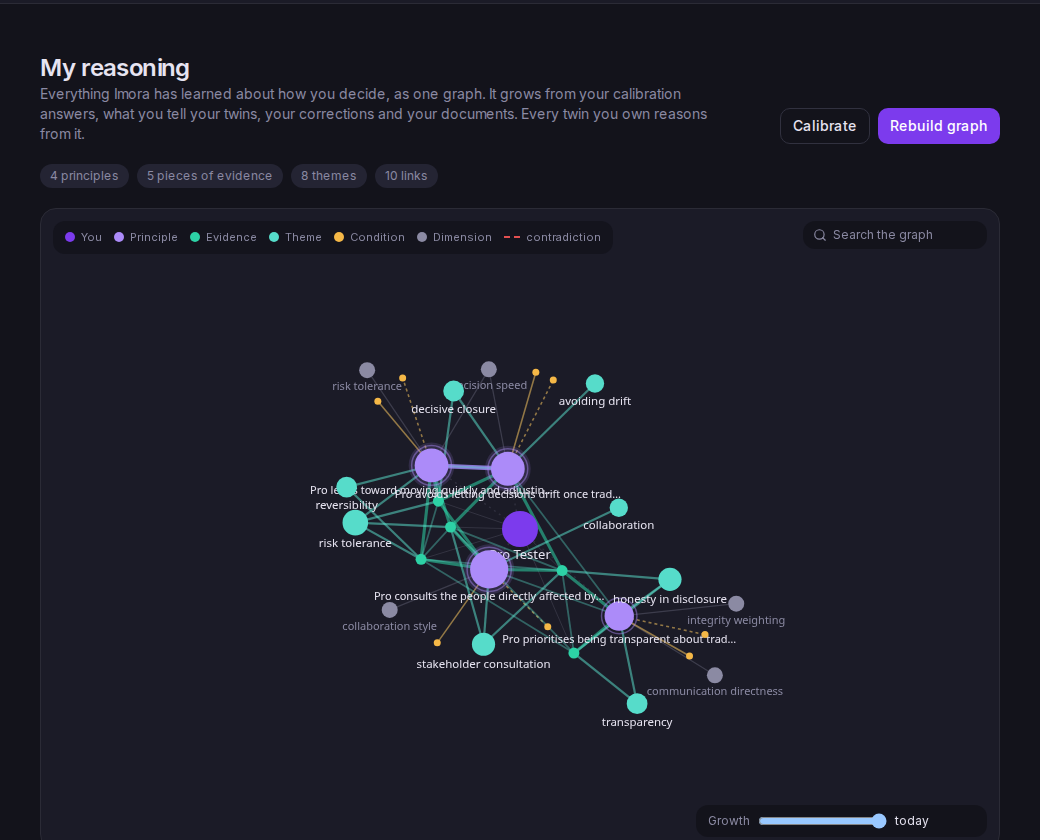
Most AI tools store facts about you. Imora stores decisions, distils them into principles, and links them into a graph that every twin you own reasons from.
- 1
Evidence
Calibration answers, corrections, things you tell your twin and quotes from documents you wrote. Verbatim, dated, yours.
- 2
Principles
Imora works out the rules you actually follow, in your terms, with the conditions and exceptions attached. Each one links back to your own words.
- 3
Links and themes
Related ideas connect, tensions stay visible instead of being averaged away, and the themes you keep coming back to surface on their own.
- 4
Reasoning at answer time
Your twin reasons from your principles and evidence, tells you how sure it can be, and answers as you. Every reply shows its work.
- 5
Growth
Nothing is flattened or forgotten. The graph gets denser with every answer, and you can replay it as it grew.
Ready to build yours?
About 10 minutes to your first answer. No technical setup. You can edit everything later.